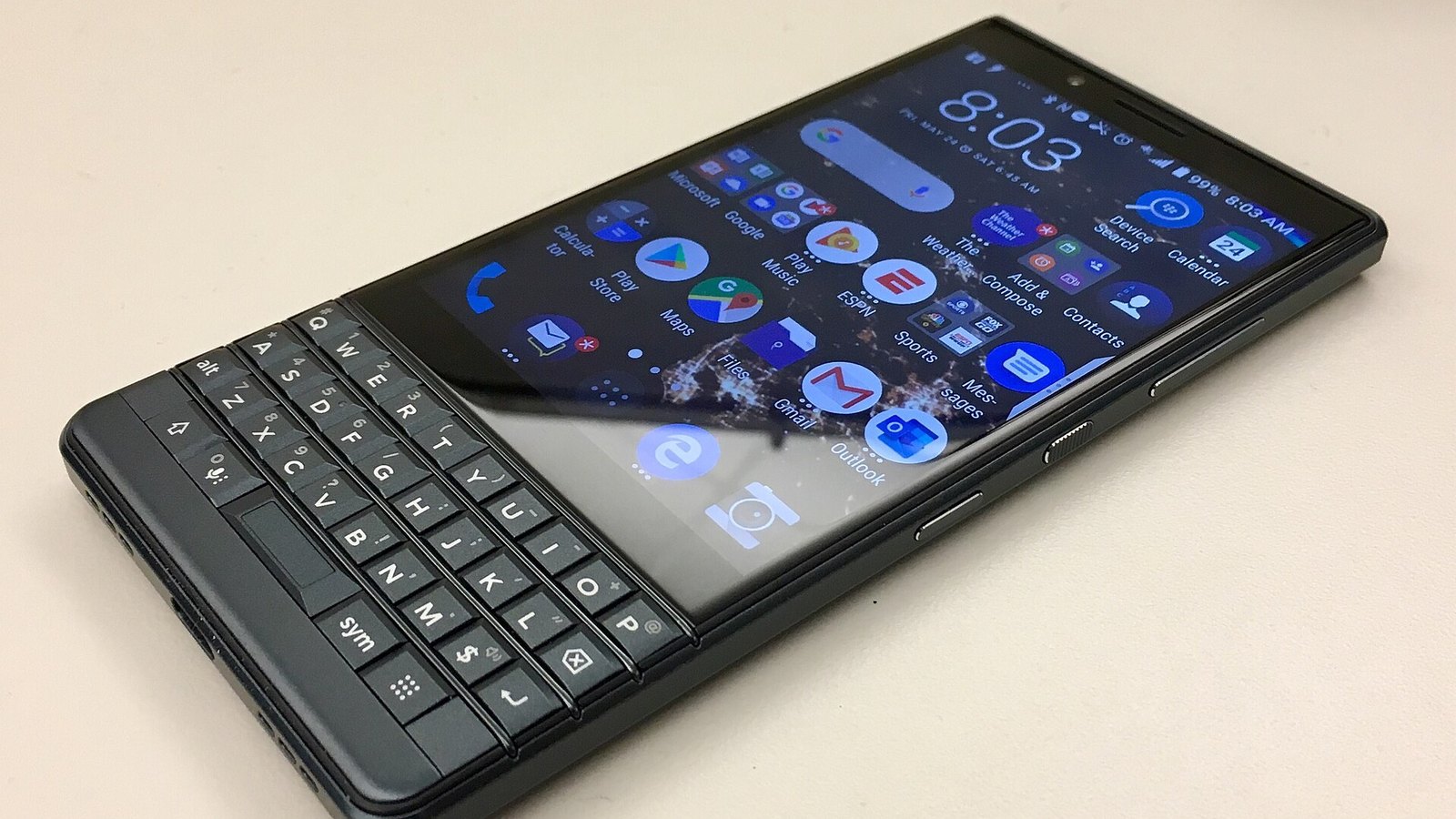
BlackBerry no longer makes phones. The company stopped designing its own hardware in 2016, the licensed TCL models ended in 2020, and on January 4, 2022 BlackBerry switched off the services that its classic phones needed to work. BlackBerry Limited still exists as a Canadian software company focused on cybersecurity and its QNX operating system for cars. Here is how the brand went from pager to phone, then to dominance, and then out of the phone business entirely.
Is BlackBerry still around?
Yes, but not as a phone maker. The company that built the BlackBerry phone was called Research In Motion (RIM) until 2013, when it renamed itself BlackBerry Limited. It still trades on the New York and Toronto stock exchanges under the ticker BB.
What it sells now has nothing to do with keyboards. Its biggest growth business is QNX, a real-time operating system embedded in car infotainment, digital cockpits and driver-assistance systems. The other half is secure communications and endpoint management for governments and large enterprises.
If you came here looking for a new BlackBerry phone to buy, there isn’t one. Any “BlackBerry” you find for sale today is old stock, refurbished, or a lookalike from another brand.
From pager to phone: Research In Motion’s early years
RIM was founded in 1984 by two engineering students, Mike Lazaridis and Douglas Fregin, in Waterloo, Ontario. For its first decade it did contract engineering and wireless data work, including point-of-sale terminals and products for the Mobitex wireless data network.
Jim Balsillie, a Harvard MBA, joined in 1992 and became co-CEO alongside Lazaridis. That pairing defined the company for the next 20 years. Lazaridis ran engineering and product, while Balsillie handled sales, carriers and finance.
The first hit was the Inter@ctive Pager. The 900 model arrived in the mid-1990s as a clamshell two-way pager, and the smaller 950 followed in 1998. It had a tiny QWERTY keyboard and could send and receive messages, which made it unusually capable for its time.
In January 1999 RIM launched the BlackBerry 850. It was still a pager, running on a single AA battery, but it did one thing better than anything else: it pushed your corporate email to your belt in real time. You didn’t have to dial in or check. The mail simply arrived.
Voice came later. The BlackBerry 5810 in 2002 could make calls, but only with a wired headset because it had no built-in speaker or microphone. The 6210 in 2003 fixed that, and from that point the BlackBerry was a phone in the full sense.
Why it’s called BlackBerry
RIM hired the naming firm Lexicon Branding to find something friendlier than “Inter@ctive Pager.” Lexicon’s team thought the small oval keys on the device looked like the drupelets on a blackberry fruit. The name was short, approachable and nothing like the cold technical names rivals used, and it stuck.
That fruit connection is why search results for “blackberry” mix phones with gardening advice. The FAQ at the end answers a few of the fruit questions too, since so many people end up searching both.
The BlackBerry phones that defined an era
RIM released dozens of models, often in multiple carrier variants with slightly different numbers. These are the ones that mattered most, either because they sold in huge volumes or because they marked a turning point.
| Model | Year | Why it mattered |
|---|---|---|
| Inter@ctive Pager 950 | 1998 | Compact two-way pager with QWERTY keys |
| BlackBerry 850 | 1999 | First BlackBerry-branded device, push email |
| BlackBerry 5810 | 2002 | First BlackBerry with voice (headset needed) |
| BlackBerry 6210 | 2003 | Built-in mic and speaker, a true phone |
| BlackBerry 7100t | 2004 | SureType keyboard aimed at consumers |
| Pearl 8100 | 2006 | Slim body, trackball, camera, media player |
| Curve 8300 | 2007 | Affordable full keyboard, a huge seller |
| Bold 9000 | 2008 | 3G, sharp screen, premium build |
| Storm 9530 | 2008 | First touchscreen BlackBerry, SurePress |
| Torch 9800 | 2010 | Slider with touch and keyboard, OS 6 |
| Z10 | 2013 | First BlackBerry 10 phone, all touch |
| Q10 | 2013 | BlackBerry 10 with a physical keyboard |
| Passport | 2014 | Square 4.5-inch screen, wide keyboard |
| Priv | 2015 | First Android BlackBerry, slider |
| KEYone | 2017 | TCL-built Android phone with keyboard |
| KEY2 | 2018 | Last major BlackBerry flagship |
The Pearl and Curve were the models that took BlackBerry from Wall Street into high schools. The Pearl replaced the scroll wheel with a trackball and added a camera, and the Curve brought the full keyboard down to a price ordinary buyers would pay. By the late 2000s, the Curve was a common first smartphone for teenagers in North America, the UK, Indonesia and South Africa.
Why BlackBerry ruled the 2000s
It’s easy to look back and think BlackBerry won on keyboards alone. That undersells it. The company built an entire system that competitors took years to match.
Push email that actually worked. BlackBerry devices didn’t poll a server every few minutes. Mail was pushed through RIM’s own network operations centers, compressed and encrypted. That kept data use low and battery life high on networks that were slow and expensive by today’s standards.
BlackBerry Enterprise Server (BES). This was the real moat. BES sat inside a company’s network and let IT departments encrypt traffic, enforce passwords, push policies and wipe lost phones remotely. Banks, law firms and governments standardized on it because nothing else gave them that much control.
BlackBerry Messenger (BBM). Launched in 2005, BBM let users message each other for free using a PIN instead of a phone number. It showed delivered and read receipts years before WhatsApp existed. For many younger users, BBM was the reason to own a BlackBerry at all.
The keyboard. RIM’s keyboards were sculpted, clicky and fast. Heavy emailers could type with their thumbs without looking. Early touchscreens couldn’t come close for accuracy.
Battery life. Low-resolution screens, efficient software and that compressed data meant a BlackBerry could last a couple of days. Early smartphones from other brands often struggled to get through one.
The cultural grip was strong enough that “CrackBerry” became shorthand for compulsive email checking. Webster’s New World College Dictionary picked it as its word of the year in 2006. When Barack Obama took office in 2009, he fought to keep using a BlackBerry, and the device he ended up with was a specially secured model.
The peak years in numbers
BlackBerry’s growth curve through the late 2000s was steep, and the collapse was steeper. RIM’s fiscal year ended in late February or early March, so “FY2011” mostly covers calendar 2010.
| Fiscal year | Revenue (US$) | What was happening |
|---|---|---|
| FY2008 | $6.0 billion | Curve and Pearl driving consumer sales |
| FY2009 | $11.1 billion | Bold and Storm launch; iPhone 3G arrives |
| FY2010 | $15.0 billion | Rapid global expansion |
| FY2011 | $19.9 billion | All-time revenue peak |
| FY2012 | $18.4 billion | PlayBook flop, 2011 outage |
| FY2013 | $11.1 billion | BlackBerry 10 delays |
| FY2014 | $6.8 billion | Z10 inventory writedown |
| FY2015 | $3.3 billion | Passport and Classic |
| FY2016 | $2.2 billion | Priv, shift to Android |
| FY2017 | $1.3 billion | Hardware design ends |
Subscribers kept growing for a while after revenue started slipping, peaking close to 80 million around 2012 and 2013. That lag fooled some observers. Plenty of those users were on cheap Curves in emerging markets, paying little and ready to switch the moment an affordable Android phone showed up.
The share price told the story faster. RIM’s market value topped roughly $80 billion in mid-2008. Five years later it was worth a small fraction of that.
How the iPhone and Android caught BlackBerry flat-footed
Apple unveiled the iPhone in January 2007. The first Android phone, the T-Mobile G1, followed in late 2008. Inside RIM, the early reaction was skepticism. The iPhone had no keyboard, weak battery life, no enterprise security to speak of and it ran only on AT&T in the US.
All of that was true in 2007. None of it mattered by 2010.
What RIM underestimated was where the value was moving. The iPhone made the web browser, apps and the screen the center of the phone. Once Apple launched the App Store in 2008 and Google’s Android spread across dozens of manufacturers, developers followed the users. BlackBerry’s app catalog never came close, and its Java-based BlackBerry OS was poorly suited to rich apps.
The second miss was the “bring your own device” shift. RIM’s sales strategy ran through IT departments. When employees started showing up with iPhones and demanding email on them, companies gave in, and Microsoft Exchange ActiveSync made it easy. BES was no longer the only secure option, so BlackBerry lost its strongest selling point.
The Storm and PlayBook misfires
RIM’s first answer to the iPhone was the BlackBerry Storm, an exclusive for Verizon in the US in late 2008. Its SurePress screen physically clicked when you pressed it, which was a clever idea on paper. In practice, early units shipped with buggy software and a sluggish screen, and the Storm became a byword for a rushed product.
The BlackBerry PlayBook tablet arrived in April 2011 at $499 for 16GB. It ran a new QNX-based operating system that was genuinely fast. But at launch it lacked a native email app unless you paired it with a BlackBerry phone, which is an astonishing omission from the email company. In late 2011 RIM took a writedown of roughly $485 million on PlayBook inventory.
The 2011 outage
In October 2011, a failure in RIM’s infrastructure knocked out email, BBM and browsing for BlackBerry users across Europe, the Middle East, Africa, Latin America and North America for about three days. The centralized network that made BlackBerry secure also made it fragile. For corporate customers already being pushed toward iPhones, the outage gave them a reason to finally switch.
BlackBerry 10: the last in-house bet
In January 2012, Lazaridis and Balsillie stepped down as co-CEOs, and Thorsten Heins took over. His job was to ship BlackBerry 10, a completely new operating system built on QNX, which RIM had bought in 2010.
BlackBerry 10 finally launched on January 30, 2013, a year later than RIM had first suggested. On the same day the company renamed itself BlackBerry. The launch phones were:
- BlackBerry Z10: 4.2-inch 1280 x 768 touchscreen, dual-core processor (Snapdragon S4 or TI OMAP depending on region), 2GB RAM, 16GB storage, 1,800 mAh removable battery, 8MP camera.
- BlackBerry Q10: 3.1-inch 720 x 720 Super AMOLED screen with a full physical keyboard, 2,100 mAh battery.
Reviewers liked BlackBerry 10’s gesture navigation and the BlackBerry Hub, a unified inbox that pulled email, texts and social messages into one place. The problem was timing. By 2013 the iPhone 5 and the Galaxy S4 had huge app libraries, and BlackBerry 10 couldn’t attract developers fast enough to close the gap.
The Z10 sold badly. In September 2013 BlackBerry announced a pre-tax inventory charge of $934 million, largely tied to unsold Z10 phones, and said it would cut about 4,500 jobs. A $4.7 billion buyout offer led by Fairfax Financial was announced the same autumn and then collapsed. John Chen, who had turned around the database company Sybase, became CEO in November 2013.
BlackBerry 10 produced two more interesting phones. The Passport (2014) had a square 4.5-inch 1440 x 1440 display and a wide three-row touch-sensitive keyboard aimed at reading documents and spreadsheets. The Classic (2014) brought back the trackpad and the familiar Bold-style layout for loyalists. Both found fans, but neither changed the trajectory.
Android BlackBerry phones and the licensing era
Chen’s strategy was clear: stop fighting the app war and turn BlackBerry into a software and security company. The phones would have to earn their place or go.
In November 2015 BlackBerry launched the Priv, its first Android phone. It paired a curved 5.4-inch display with a slide-out keyboard and BlackBerry’s security tweaks on top of Android. The Priv was well built but expensive at $699 in the US, and sales were modest.
In September 2016 BlackBerry announced it would stop designing phones in-house. From then on, partners would build BlackBerry-branded devices under license, and BlackBerry would supply the software and security layer. TCL Communication took the global license, while Optiemus held India and BB Merah Putih held Indonesia.
| Model | Year | Chip | Display | Battery | Keyboard |
|---|---|---|---|---|---|
| Priv | 2015 | Snapdragon 808 | 5.4 in curved AMOLED | 3,410 mAh | Slide-out |
| DTEK50 | 2016 | Snapdragon 617 | 5.2 in LCD | 2,610 mAh | None |
| KEYone | 2017 | Snapdragon 625 | 4.5 in LCD, 3:2 | 3,505 mAh | Fixed QWERTY |
| KEY2 | 2018 | Snapdragon 660 | 4.5 in LCD, 3:2 | 3,500 mAh | Fixed QWERTY |
The KEYone was the most successful of the bunch. Its battery life was excellent, and the keyboard doubled as a touch-sensitive trackpad for scrolling. The KEY2 refined that formula with a dual camera and a thinner build, and it remains the phone most people mean when they ask about the “last real BlackBerry.”
TCL announced in February 2020 that it would stop selling BlackBerry phones after August 31, 2020. A Texas startup called OnwardMobility then announced plans for a 5G Android BlackBerry with a keyboard for 2021. That phone never shipped. BlackBerry ended the license, and OnwardMobility shut down in early 2022.
The 2022 shutdown: what stopped working
On January 4, 2022, BlackBerry ended support for the infrastructure behind its legacy operating systems. The company had announced the date well in advance and warned that affected devices would no longer reliably handle data, calls, texts or even emergency calls.
| Platform | Examples | Status after Jan 4, 2022 |
|---|---|---|
| BlackBerry OS 7.1 and earlier | Curve, Bold, Pearl, Torch | Unreliable data, calls, SMS and 911 |
| BlackBerry 10 | Z10, Q10, Passport, Classic, Leap | Unreliable data, calls, SMS and 911 |
| BlackBerry PlayBook OS 2.1 and earlier | PlayBook tablet | Services shut down |
| Android (BlackBerry-branded) | Priv, DTEK50, KEYone, KEY2 | Still work, but no longer updated |
The consumer BBM app had already gone. BlackBerry handed it to Indonesian company Emtek in 2016, and that version closed on May 31, 2019.
Watch out
Android BlackBerry phones survived the 2022 shutdown, but they are stuck on old Android versions with no security patches. Do not use one for banking or work email.
What BlackBerry Limited does now
Strip away the phones and BlackBerry still owns some valuable technology.
QNX. This is the company’s crown jewel. QNX is a real-time operating system that runs safety-critical software in cars, medical devices and industrial equipment. BlackBerry says QNX software is embedded in more than 200 million vehicles, supplying most of the world’s major automakers and Tier 1 suppliers.
Secure communications. BlackBerry sells secure messaging and endpoint management tools to governments and regulated industries. This is the direct descendant of BES, the product that made the BlackBerry phone indispensable to IT departments.
Cylance, briefly. BlackBerry bought AI security company Cylance in 2019 for $1.4 billion to anchor its cybersecurity push. The deal never delivered the hoped-for growth, and BlackBerry agreed to sell Cylance to Arctic Wolf in late 2024.
The patent sale. In 2023, BlackBerry agreed to sell most of its legacy mobile patents to Malikie Innovations for up to $900 million, combining upfront cash with future royalties. That deal effectively closed the book on BlackBerry as a mobile hardware company.
John Chen retired as CEO in late 2023, and John Giamatteo, previously head of the cybersecurity unit, took over. The company that once made around $20 billion a year now reports annual revenue well under $1 billion.
Why BlackBerry really fell: five lessons
Plenty of business-school case studies boil the BlackBerry story down to “they ignored the iPhone.” That’s too simple. Here’s a sharper reading.
- It optimized for the buyer, not the user. RIM sold to IT departments and carriers. When consumers became the people who decided which phone a company would support, RIM had no instinct for what they wanted.
- Its strengths became constraints. The centralized network that made email secure and efficient also made BlackBerry dependent on its own servers, carrier fees and a single point of failure.
- It replaced its OS too late. BlackBerry 10 was good. Had it launched in 2010 instead of 2013, the outcome might have been different. By 2013, developers had already committed to iOS and Android.
- Half-measures confused buyers. The Storm, the Torch and the PlayBook each tried to answer the iPhone without fully committing. None of them did any single thing better than the competition.
- Emerging markets masked the decline. Strong subscriber numbers in Indonesia, Nigeria and the Gulf states made the business look healthier than it was. Those users were price-sensitive and moved to cheap Android phones quickly.
The fair counterpoint is that BlackBerry survived. Many 2000s phone makers ended up absorbed or reduced to licensed brand names. BlackBerry rebuilt itself around software it already owned, which is more than most fallen giants manage.
Can you still use a BlackBerry phone today?
You can, with big caveats. Classic BlackBerry OS and BlackBerry 10 devices are effectively museum pieces now. They may power on, but carriers have also shut down their 3G networks (AT&T, T-Mobile and Verizon all retired 3G in the US during 2022), and many older BlackBerry phones can’t make calls without it.
The Android models are the only practical option. A KEY2 or KEYone still works as a phone if your network supports it, but TCL’s update promise ran only until August 2022. The KEY2 never got an official update beyond Android 8.1, so many current apps will eventually stop supporting it.
Buying tip
Before buying a used KEY2, confirm the exact model number supports your carrier’s LTE bands and VoLTE. Without VoLTE, it may not make calls on a 4G-only network.
If you want a keyboard phone for a second line, a cheap plan from one of the prepaid wireless carriers keeps the risk low. Just check that the carrier allows the device on its network before you pay for it, since some keep strict lists of approved phones.
If what you really miss is a physical keyboard, newer options exist. Unihertz makes Android phones with BlackBerry-style keyboards in its Titan series, and Clicks sells keyboard cases that clip onto recent iPhones and some Android phones. For a modern daily driver with current security updates, though, you’re better off working through how to choose a phone from today’s lineups and adding a keyboard case if you can’t live without one.
BlackBerry on screen: the 2023 film
The brand’s story got a Hollywood-style retelling in 2023. BlackBerry, directed by Matt Johnson, stars Jay Baruchel as Mike Lazaridis and Glenn Howerton as Jim Balsillie. It is loosely based on the 2015 book Losing the Signal by journalists Jacquie McNish and Sean Silcoff.
The film compresses timelines and plays up personalities for drama, so treat it as entertainment rather than a documentary. The book is the more reliable account if you want the business detail, including the Storm launch, the BES strategy and the backdating scandal over stock options that cost Balsillie his chairman role in 2007.
FAQ
Is BlackBerry still present?
BlackBerry Limited still exists and trades as BB on the NYSE and TSX, but it no longer sells phones. It makes QNX software for cars and security products for governments and enterprises. Classic BlackBerry OS and BlackBerry 10 phones lost service on January 4, 2022.
What was the last BlackBerry phone?
The last major global flagship was the TCL-built BlackBerry KEY2 in 2018, followed by the cheaper KEY2 LE later that year. Licensed models like the Evolve sold in India in 2018. TCL stopped selling BlackBerry phones after August 31, 2020, and a planned 5G model from OnwardMobility never launched.
Why did people love BlackBerry phones?
Fast physical keyboards, reliable push email, long battery life and BBM. For businesses, BlackBerry Enterprise Server gave IT teams encryption and remote control over devices that no rival matched until around 2010.
How do blackberries reproduce?
The fruit plant reproduces two ways. Sexually, each drupelet holds a seed, and birds and mammals spread those seeds after eating the berries. Vegetatively, many blackberries spread by root suckers, and trailing types root wherever a cane tip touches the soil, a process called tip layering. That second method is why wild brambles spread so fast.
What are the differences between a dewberry and a blackberry?
Dewberries are trailing Rubus species that grow low along the ground rather than on upright arching canes. They usually ripen earlier in the season, carry fewer berries per cluster, and their fruit tends to have fewer, larger drupelets. Blackberries typically grow on taller erect or semi-erect canes.
What are the key differences between blackberries and black raspberries?
Pick one and look at the inside. A black raspberry pulls away from its white core, so the berry is hollow. A blackberry keeps the core, so the berry is solid. Black raspberries are also smaller, have a slightly fuzzy surface, ripen earlier in summer, and grow on canes with a waxy white-blue coating.