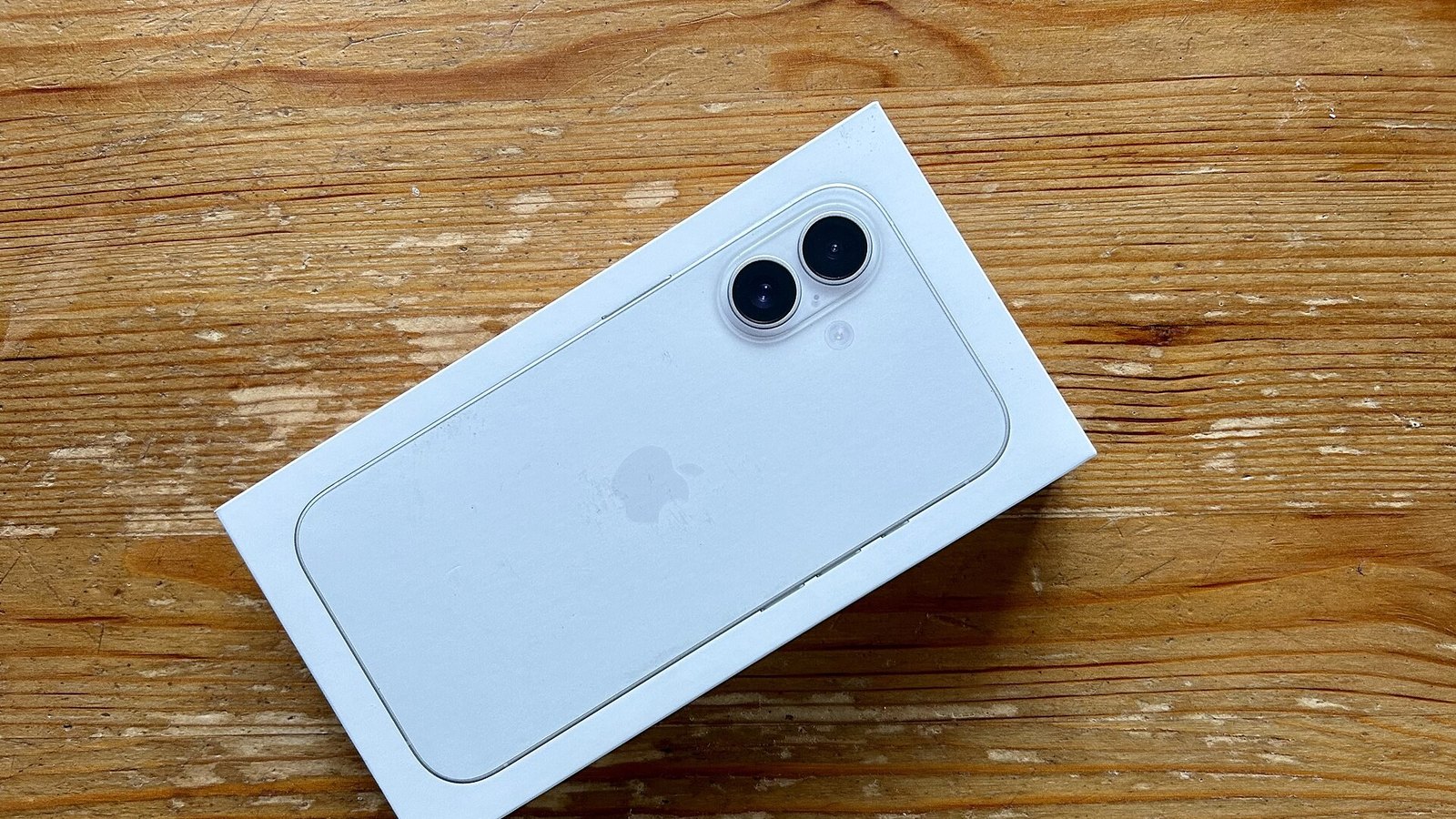
The iPhone 17 is Apple’s standard 2025 iPhone, priced from $799 with 256GB of storage, and it is the first base model to get a 120Hz ProMotion display, an always-on screen and a 48MP ultra wide camera. I think it is the most sensible iPhone Apple has sold in years, because it absorbs features that used to justify the Pro price without raising the entry cost.
iPhone 17 specs compared with the iPhone 16
Apple announced the iPhone 17 at its September 9, 2025 event alongside the iPhone Air, iPhone 17 Pro and iPhone 17 Pro Max. Preorders opened on September 12 and the phone went on sale on September 19, 2025. The table below sets the base model against the phone it replaced, using Apple’s published spec pages.
| Spec | iPhone 17 | iPhone 16 |
|---|---|---|
| Display | 6.3 in OLED, ProMotion 1-120Hz, always-on | 6.1 in OLED, 60Hz |
| Peak outdoor brightness | 3,000 nits | 2,000 nits |
| Chip | A19 (6-core CPU, 5-core GPU) | A18 |
| Base storage | 256GB | 128GB |
| Main camera | 48MP Fusion, f/1.6 | 48MP Fusion, f/1.6 |
| Ultra wide | 48MP | 12MP |
| Front camera | 18MP Center Stage | 12MP |
| Video playback (Apple claim) | Up to 30 hours | Up to 22 hours |
| Wired fast charge | 50% in 20 min (40W adapter) | 50% in 30 min (20W adapter) |
| Front glass | Ceramic Shield 2 | Ceramic Shield |
| Launch price (US) | $799 (256GB) | $799 (128GB) |
Apple does not publish RAM figures. Developer tool reports and teardowns put the iPhone 17 at 8GB, the same amount the iPhone 16 needed to run Apple Intelligence.
What’s new: the seven upgrades that matter
1. A 120Hz ProMotion display with always-on
For years the standard iPhone stayed at 60Hz while almost every Android phone at the same price moved to 120Hz. The iPhone 17 finally closes that gap with a ProMotion panel that scales from 1Hz to 120Hz, which also enables the always-on lock screen previously reserved for the Pro models. The screen grows from 6.1 to 6.3 inches thanks to slimmer bezels, and peak outdoor brightness rises to 3,000 nits, so the look and feel of scrolling is now on par with the Pro.
2. Double the storage at the same price
The base model now starts at 256GB for $799, with a 512GB option at $999. There is no 128GB tier anymore, which means Apple effectively removed a $100 upgrade most buyers ended up paying for anyway, especially anyone shooting 4K video or keeping a large photo library on the device.
3. The A19 chip
The A19 is built on TSMC’s third-generation 3nm process and pairs a 6-core CPU (two performance cores, four efficiency cores) with a 5-core GPU. Apple added Neural Accelerators to each GPU core, which matters for on-device Apple Intelligence features and for games that use hardware ray tracing. The Pro models get the A19 Pro with a 6-core GPU, while the standard chip handles messaging, browsing, photo editing and most games comfortably.
4. Two 48MP rear cameras and a new selfie sensor
The rear setup, which Apple calls Dual Fusion, now uses two 48MP sensors. The main camera carries over the f/1.6 aperture and sensor-shift stabilization, and it still produces a 2x optical-quality crop that works as a stand-in telephoto. The bigger change is the ultra wide, which jumps from 12MP to 48MP and should give sharper macro shots and better detail in wide landscapes.
The front camera is the more interesting upgrade. It is an 18MP Center Stage camera with a square sensor, so you can take a landscape group selfie while still holding the phone upright, and the frame can widen automatically when more people step in. Dual Capture also lets you record from the front and rear cameras at the same time, a feature creators have wanted from Apple for a long time.
5. Longer battery life and faster charging
Apple rates the iPhone 17 for up to 30 hours of video playback, eight hours more than the iPhone 16 claim. Apple does not list battery capacity in mAh, so I treat the playback figure as the official benchmark rather than quoting unverified numbers. With a 40W or higher USB-C adapter, the phone reaches 50% in about 20 minutes, and MagSafe and Qi2.2 wireless charging run at up to 25W with a 30W adapter.
6. Tougher front glass
Ceramic Shield 2 covers the display and, according to Apple, offers three times better scratch resistance than the previous generation, along with a coating that reduces reflections. The phone keeps its IP68 rating, tested to 6 meters for up to 30 minutes, and an aluminum frame.
7. Apple’s N1 wireless chip
Every iPhone 17 model uses Apple’s own N1 chip for Wi-Fi 7, Bluetooth 6 and Thread. That gives better reliability for features like Personal Hotspot and AirDrop, plus faster local networking on a Wi-Fi 7 router. The cellular modem in the base iPhone 17 still comes from Qualcomm; only the iPhone Air uses Apple’s own C1X modem.
Buying tip
If you rely on a physical SIM card, check your region first: US iPhone 17 models are eSIM-only, and your carrier must support eSIM activation.
Design, colors and iOS 26
Physically, the iPhone 17 looks like a close follow-up to last year’s model, with a vertical camera pairing on the back, the Action button and the Camera Control button on the side. It measures 7.95mm thick and weighs 177 grams. Colors are Black, White, Mist Blue, Sage and Lavender, a softer palette than the Cosmic Orange that drew attention on the Pro.
It ships with iOS 26 and its Liquid Glass interface, which uses translucent layered elements across the lock screen, controls and apps. The new design benefits from the 120Hz screen, since the animations and blur effects feel smoother at higher refresh rates. Apple Intelligence features such as Live Translation in Messages, FaceTime and Phone also run on the base model.
What the base model still leaves out
The standard model closes most of the gap with the Pro, but not all of it, and a few omissions are worth knowing before you buy.
- No dedicated telephoto. The 2x crop is good, but the iPhone 17 Pro has a 48MP telephoto with 4x optical zoom and up to 8x optical-quality zoom.
- USB 2 speeds. The USB-C port still transfers at USB 2 speeds, which slows large video offloads compared with the Pro’s USB 3.
- No vapor chamber. Apple gave the 17 Pro models a vapor chamber cooling system for sustained performance; the base iPhone 17 relies on conventional heat dissipation, so long gaming sessions may throttle sooner.
- No ProRes RAW or Log-focused pro video tools of the kind the Pro models target at filmmakers.
Watch out
US models have no SIM tray at all. If you travel with local physical SIMs, or switch carriers often, confirm eSIM support before you order.
Where the iPhone 17 sits in the 2025 lineup
The price ladder explains a lot about who each phone is for. At launch in the US, the iPhone 16e was the entry point at $599 (it has since been replaced by the iPhone 17e, which also launched at $599), the iPhone 17 started at $799, the iPhone Air at $999, the iPhone 17 Pro at $1,099 and the iPhone 17 Pro Max at $1,199. In the UK, the iPhone 17 starts at £799, and in India it launched at ₹82,900.
The iPhone Air offers a taste of where Apple’s design is heading, at 5.6mm thin, but it has a single rear camera and a smaller battery claim than the iPhone 17. The Pro Max solves bigger problems for heavy users: the largest battery, the telephoto and the vapor chamber. The base iPhone 17 is the one that covers the most people, and the gap between it and the $1,099 Pro is now mostly zoom, cooling and video tools rather than everyday screen quality.
There is no Plus model this year. If you want a bigger screen without paying Pro Max prices, the closest option is the 6.5-inch iPhone Air, which costs $200 more than the iPhone 17.
Who should buy the iPhone 17
I would point most iPhone 13, 14 and 15 owners toward the iPhone 17. The 120Hz display, the doubled storage and the battery claim add up to a substantial change in daily use, and the $799 price has not moved. Owners of an iPhone 16 Pro already have ProMotion and a telephoto, so the case for them is much weaker.
Buyers coming from Android who are used to high refresh screens no longer have a reason to dismiss the standard iPhone on display grounds. If you are still deciding how to choose a phone across brands, the iPhone 17 is now a fair baseline for what a $799 flagship should offer.
The iPhone 17 also works well on budget plans. It is unlocked-friendly and pairs fine with prepaid wireless carriers, provided the carrier you pick supports eSIM in the US. The only buyers I would steer to the Pro are those who need optical zoom for kids’ sports, concerts or wildlife, or who shoot serious video and transfer large files over cable.
FAQ
When was the iPhone 17 released?
Apple announced the iPhone 17 on September 9, 2025, opened preorders on September 12 and released it in stores on September 19, 2025.
How much does the iPhone 17 base model cost?
The iPhone 17 costs $799 in the US for 256GB and $999 for 512GB. UK pricing starts at £799.
Does the iPhone 17 have a 120Hz display?
Yes. It is the first standard iPhone with a ProMotion display that adjusts from 1Hz to 120Hz, and it supports the always-on lock screen.
What is the difference between the iPhone 17 and iPhone 17 Pro?
The Pro adds the A19 Pro chip, a 48MP telephoto with 4x optical zoom, a vapor chamber for cooling, USB 3 speeds and pro video features. The two share a 6.3-inch 120Hz display size and the same 18MP Center Stage front camera.
Does the iPhone 17 have a SIM card slot?
Not in the US, where it is eSIM-only. Models sold in many other regions, including the UK and India, still include a physical SIM tray.
How much RAM does the iPhone 17 have?
Apple does not publish RAM figures, but developer tool reports and teardowns indicate 8GB.