









Huawei no longer sells the Mate 30 Pro new. It was announced in Munich on 19 September 2019, and several generations have replaced it since. The current flagship is the Mate 90 Pro, launched in China on 1 October 2026 with a Kirin 9035 chip and HarmonyOS 7. Chinese units of the Mate 30 Pro were still getting HarmonyOS 4.2 maintenance builds in 2025, but global units never had Google Play services. If you are looking at a used one today, check three things: battery health, the software version it runs, and whether the apps you rely on are in Huawei’s AppGallery.
The launch: a strong flagship that arrived without Google
The Mate 30 Pro was one of the most anticipated phones in Huawei’s Mate series. Huawei unveiled it with the Mate 30 at an event in Munich on 19 September 2019. Sales in China began on 26 September 2019, and the 8GB/256GB model was priced at €1,099 in Europe.
The phone had a powerful chip, a fast-charging battery and a camera system that reviewers rated among the best of 2019. A US trade ban hung over all of it.
Kirin 990: Huawei’s most powerful chip at the time
The Mate 30 Pro used the HiSilicon Kirin 990. When it launched, this was the most powerful chip Huawei had made. It has eight CPU cores in three clusters, plus a Mali-G76 MP16 GPU. The standard Mate 30 Pro used the 4G Kirin 990, built on a 7 nm process. A separate Mate 30 Pro 5G model used the Kirin 990 5G, built on an improved 7 nm+ process.
By 2026 standards, the Kirin 990 is old. It still handles everyday apps, but newer chips easily beat it for heavy games and on-device processing. The Kirin 9030 in the Mate 80 Pro and the Kirin 9035 in the Mate 90 Pro are both far newer designs.
Android 10 without Google services
The Mate 30 Pro shipped with EMUI 10 based on Android 10. It had none of Google’s apps and services: no Play Store, no Gmail, no Google Maps. The reason was the US government’s trade restrictions on Huawei, which blocked it from licensing Google Mobile Services. That made the phone a hard sell outside China, and many buyers thought twice.
Before release, there was speculation that Huawei would partner with a third party to bring Google apps to the phone. That never happened. Huawei put its own Huawei Mobile Services and the AppGallery store on the phone instead, and Richard Yu, head of Huawei’s consumer business, pointed users to web versions of some Google services. Officially, the Mate 30 Pro never got Google Play.
Software updates since launch
Updates split by region after launch:
- Global models moved from EMUI 10 to EMUI 11 and still had no Google services.
- Chinese models switched to HarmonyOS. Huawei Central reported a HarmonyOS 4.2.0.125 update for the Mate 30 series in August 2024, and IT Home later reported HarmonyOS 4.2.0.136 builds for the Mate 30 Pro.
- Current HarmonyOS releases, HarmonyOS 6 on the Mate 80 series and HarmonyOS 7 on the Mate 90 series, are for much newer hardware.
The camera system
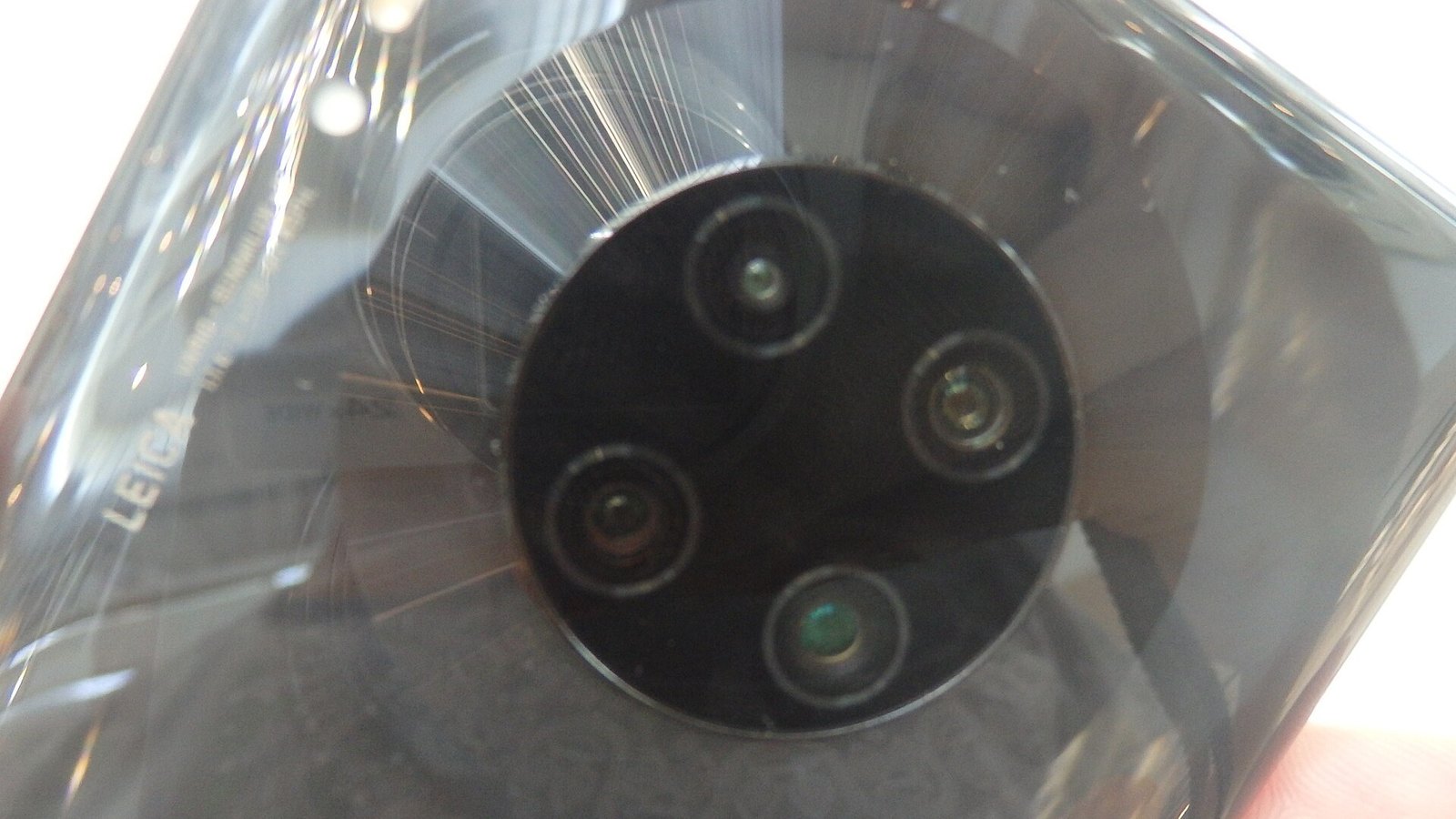
The camera was the Mate 30 Pro’s best feature, and it held up well against rivals in 2019. On the back is a four-camera setup developed with Leica:
- A 40MP main wide camera, f/1.6, with optical image stabilisation
- A 40MP ultra-wide camera, f/1.8, 18mm, which Huawei pitched for video
- An 8MP telephoto camera, f/2.4, with 3x optical zoom
- A 3D Time-of-Flight (ToF) sensor for depth sensing
On the front are a 32MP selfie camera and a 3D depth sensor. Huawei also promoted the phone’s 7,680fps ultra slow-motion video mode.
Two 40MP sensors on one phone was unusual in 2019. The old wording here called the depth sensor “Time-of-Light”; the correct term is Time-of-Flight.
Memory and storage
Huawei offered one RAM size and two storage options: 8GB RAM with 128GB storage, or 8GB RAM with 256GB storage. You could add more storage with Huawei’s own NM (Nano Memory) card instead of a standard microSD card.
In 2019, 8GB of RAM was plenty for running a heavy game like PUBG Mobile alongside Instagram without slowdowns. Flagships have moved on since then. The Mate 80 Pro comes with 12GB or 16GB of RAM.
Weak points
The Mate 30 Pro did have some real downsides.
Display resolution. The 6.53-inch OLED “Horizon” display curves steeply over both sides. Its resolution is 2,400 x 1,176 pixels, about 409 pixels per inch. That is slightly sharper than standard FHD+ but well short of the QHD+ panels on some 2019 rivals. In daily use it looked sharp. Some buyers still expected a higher resolution at this price.
Design. The large circular camera module on the back divided opinion. Some people liked its bold look, and others found it unattractive.
Software. The missing Google services were the biggest weakness by far, especially for buyers outside China.
Key specs of the Huawei Mate 30 Pro
- OS at launch: Android 10, EMUI 10 (global units later moved to EMUI 11; Chinese units moved to HarmonyOS)
- Screen tech: OLED, curved “Horizon” display
- Screen size: 6.53 inches
- Resolution: 1,176 x 2,400 pixels
- Chip: HiSilicon Kirin 990 (7 nm); Kirin 990 5G (7 nm+) on the Mate 30 Pro 5G
- CPU: Octa-core (2x 2.86 GHz Cortex-A76, 2x 2.09 GHz Cortex-A76, 4x 1.86 GHz Cortex-A55)
- GPU: Mali-G76 MP16
- Memory and storage: 8GB RAM with 128GB, or 8GB RAM with 256GB; NM card slot
- Selfie cameras: 32MP wide, plus a 3D depth (ToF) sensor
- Main cameras: 40MP f/1.6 wide; 40MP f/1.8 ultra-wide (18mm); 8MP f/2.4 telephoto (3x optical); 3D ToF sensor
- Battery: 4,500 mAh Li-Po, non-removable
- Charging: 40W wired, 27W wireless, reverse wireless charging
- Build: IP68 dust and water resistance, 158.1 x 73.1 x 8.8 mm, 198 g
- Launch price: €1,099 (8GB/256GB, Europe)
What replaced the Mate 30 Pro
Huawei puts out a new Mate generation roughly once a year. The two newest Pro models now launch with Kirin chips and HarmonyOS, and their launch prices are for China.
| Mate 30 Pro | Mate 80 Pro | Mate 90 Pro | |
|---|---|---|---|
| Announced | 19 Sept 2019 | 25 Nov 2025 | 1 Oct 2026 |
| Chip | Kirin 990 | Kirin 9030 (Kirin 9030 Pro on 16GB models) | Kirin 9035 |
| Display | 6.53 in OLED | 6.75 in LTPO OLED, 120 Hz | 6.75 in tandem LTPO OLED |
| Battery | 4,500 mAh | 5,750 mAh | 6,600 mAh |
| Wired / wireless charging | 40W / 27W | 100W / 50W | Not listed here |
| Software at launch | EMUI 10 (Android 10) | HarmonyOS 6 | HarmonyOS 7 |
| Launch price | €1,099 (Europe) | From 5,999 yuan (China) | From 6,999 yuan (China) |
The Mate 90 Pro has the biggest battery and the newest chip. Android Authority has reported that Huawei has no plans to sell the Mate 90 phones outside China. If you live elsewhere and need Google apps, a Huawei Mate is still not a simple choice.
FAQ
Is the Huawei Mate 30 Pro still worth buying in 2026?
Only as a cheap used phone for photos. The camera still takes good pictures, but the Kirin 990 is six years old, the battery in most units has aged, and there are no Google services. Most buyers will get better value from a newer mid-range phone with current software support.
Does the Mate 30 Pro have Google Play Store?
No. Because of US trade restrictions, Huawei could not license Google Mobile Services for the Mate 30 series. The phone uses Huawei Mobile Services and the AppGallery store instead.
Is the Mate 30 Pro still getting updates?
In China, the Mate 30 series got HarmonyOS 4.2 maintenance builds through 2024 and into 2025. Global units stopped at EMUI 11. Do not expect new feature updates for either version.
Does the Mate 30 Pro support 5G?
The standard Mate 30 Pro is a 4G phone with the Kirin 990. Huawei also sold a separate Mate 30 Pro 5G with the Kirin 990 5G. Check the exact model before you buy a used unit.
What is the newest Huawei Mate phone?
The Mate 90 series, launched in China on 1 October 2026, is the newest. It includes the Mate 90, Mate 90 Pro, Mate 90 Pro Max and Mate 90 RS Ultimate Design. The Mate 90 Pro starts at 6,999 yuan.
Sources
- GSMArena: Huawei Mate 30 Pro specifications
- Android Authority: Huawei Mate 30 Pro specs
- Mobile World Live: Huawei debuts Mate 30 without Google apps
- PetaPixel: Huawei unveils Mate 30 Pro with Leica cameras and 7,680fps slow motion
- Huawei Central: Mate 30 series August 2024 update
- Gizmochina: Huawei Mate 80 and Mate 80 Pro launch
- Gizmochina: Huawei Mate 90 Pro launches with Kirin 9035
About this article
- Fact-checked before publication.
- Published · Updated