









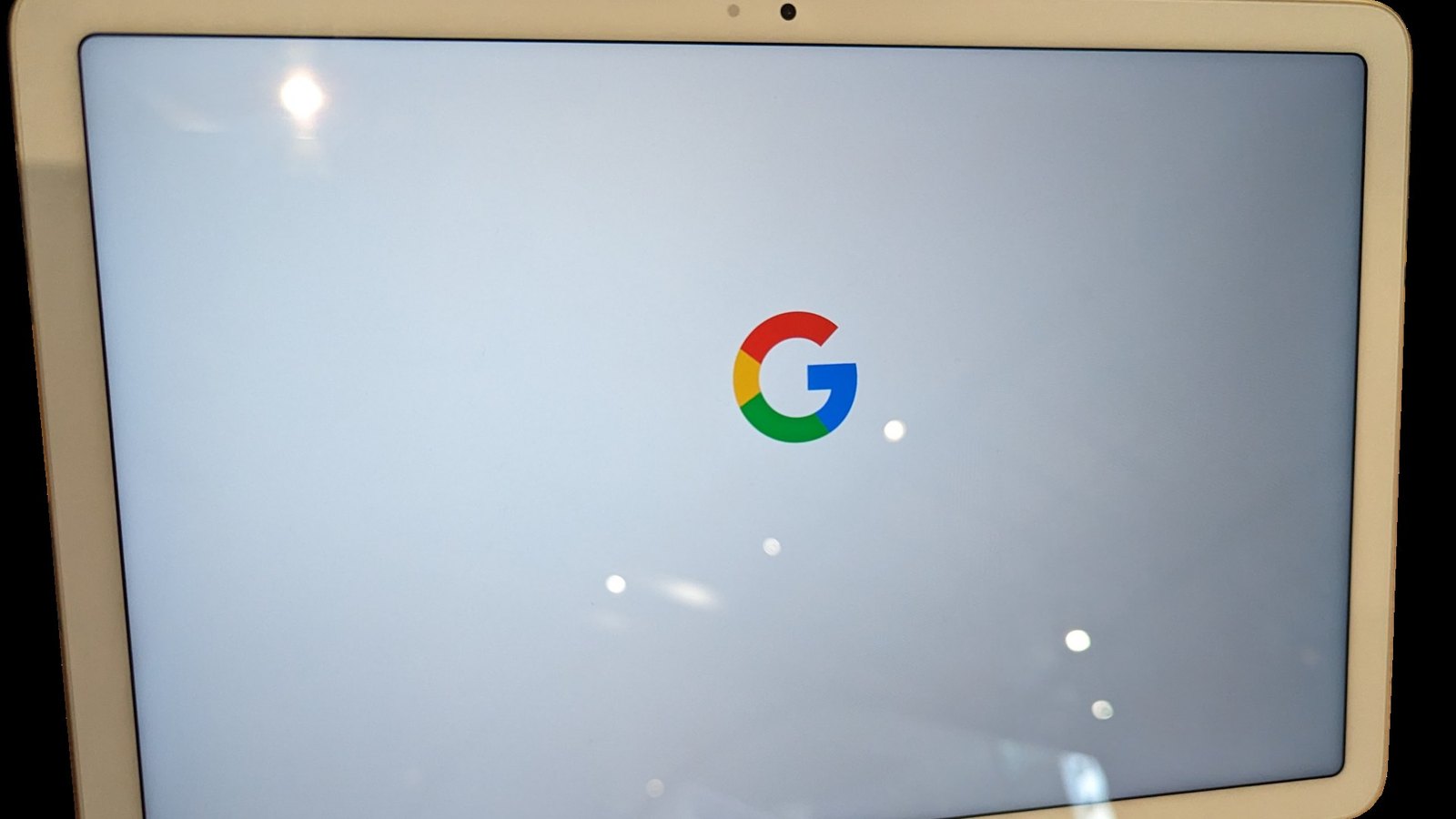
You can’t buy the Google Pixel Slate new anymore. Google said in June 2019 that it would stop making tablets, and the Slate was later dropped from sale. ChromeOS updates still arrive, and Google’s support page lists the Slate’s Auto Update Expiration as August 2027. Google’s next tablet, the Android-based Pixel Tablet (2023), was itself pulled from the Google Store in September 2026, and no successor has been announced. If you’re shopping today, only buy a used Slate i5 if it’s cheap and you can live with it losing updates in 2027. Check the battery, the keyboard and the pen before you pay. Otherwise, a current iPad, Samsung Galaxy Tab or ChromeOS tablet will serve you better.
The Google Pixel Slate i5 has a 12.3-inch screen at 3000 x 2000. That works out to 293 pixels per inch, so detail looks very fine. The 3:2 shape suits documents and web pages, and it handles films well too. When this review was first written, the tablet ran an 8th-generation Intel Core i5-8200Y processor (1.3GHz base) on Chrome OS 71.
The i5 model has 8GB of RAM and 128GB of storage. Storage is fixed, and there is no memory card slot. It connects over 802.11ac Wi-Fi and has 8-megapixel cameras on the front and back. The tablet measures about 11.5 x 7.9 x 0.3 inches and weighs 1.6 pounds without the keyboard.
At launch, the i5 model cost $999. Google’s Pixel Slate Keyboard was $199 and the Pixelbook Pen was $99, so the full set came to about $1,300. That high price is where the “overpriced” verdict came from. In 2019 and 2020, the Google Store and Best Buy ran heavy discounts. PhoneArena reported one Google Store deal that took $350 off each model and added the keyboard and pen for free. The “on sale” note in this review’s original headline referred to promotions like these. They are long over.
| Model (2018 launch lineup) | Chip | RAM | Storage | US launch price |
|---|---|---|---|---|
| Pixel Slate | Intel Celeron | 4GB | 32GB | $599 |
| Pixel Slate | Intel Celeron | 8GB | 64GB | $699 |
| Pixel Slate | 8th Gen Intel Core m3 | 8GB | 64GB | $799 |
| Pixel Slate | 8th Gen Intel Core i5 | 8GB | 128GB | $999 |
| Pixel Slate | 8th Gen Intel Core i7 | 16GB | 256GB | $1,599 |
Design and Build
The Pixel Slate came in Midnight Blue and has an anodized aluminium body that feels solid. Its bezels look thick next to the 2018 iPad Pro. Without the keyboard, the Slate weighs 1.6 pounds and is 0.3 inches thick. That made it a bit lighter than its 2018 rivals: the Microsoft Surface Pro 6 weighed about 1.7 pounds and the Samsung Galaxy Book2 about 1.8 pounds, both at roughly 0.3 inches thick. The 2018 12.9-inch iPad Pro was lighter and thinner, at about 1.4 pounds and 0.23 inches.
With the keyboard attached, the weight jumps to about 2.9 pounds and the thickness roughly doubles to 0.6 inches. That’s heavier and thicker than Google’s own Pixelbook laptop, which weighed about 2.5 pounds and was 0.4 inches thick. With their keyboards attached, the Galaxy Book2 and Surface Pro 6 were in the same range.
Ports and Connectivity
The Slate has two USB Type-C ports, and it reads external drives. In 2018 that gave it more flexibility than the iPad Pro. Both the Slate and the iPad Pro beat the Surface Pro 6 here, because the Surface had no USB-C port and needed an adapter costing about $80 to add one.
The Slate had one serious flaw at launch. Early reviews reported that copying a very large, multi-gigabyte file could make it crash and reboot: the screen went black, and then a new, blank Chrome tab opened. Smaller file transfers worked fine.
The keyboard attaches magnetically through pogo pins on the bottom edge. There’s no headphone jack, but Google put a USB-C to 3.5mm audio adapter in the box.
Display and Touch
The 12.3-inch 3000 x 2000 screen, which Google called a “Molecular Display”, shows rich colour and fine detail. It is bright enough to use comfortably, and viewing angles are good.
Touch response is quick. Web pages scroll smoothly, and swiping up from the bottom of the screen reacts at once. You can run two apps side by side in split-screen, in both tablet mode and laptop mode.
Keyboard and Pen
The Pixel Slate Keyboard has a folio stand that tilts to any angle from about 135 degrees down to roughly 90 degrees. The 2018 iPad Pro’s Smart Keyboard Folio offered only two fixed angles.
The Pixelbook Pen uses Wacom AES technology. Google listed it at 2,000 levels of pressure sensitivity, about half the 4,096 levels Samsung and Microsoft quoted for the S Pen and the Surface Pen. Apple has never published a figure for the Apple Pencil.
The pen also has a Google Assistant feature. You hold its button, circle something on screen, and Assistant tries to identify it. Results were mixed. It did well at picking out people circled in a photo and less well with other content. Features like this now live on in Android phones as Circle to Search.
Google Pixel Slate: The Positives
The Slate was a strong tablet for both work and entertainment. Its weak points were the price, some early software bugs and its weight once the keyboard was on.
Power and Spec Options
The Slate came in five configurations. The cheapest ran an Intel Celeron and cost $599. Reviewers found the Celeron models sluggish, a bit like buying a Porsche and only ever driving it in first gear. For real performance, the 8th-gen Core i5 ($999) or Core i7 ($1,599) made more sense. The i5 with 8GB of RAM handled everyday work smoothly in launch reviews. The i7 was hard to justify at $600 more. It did double the RAM to 16GB, though, which helps if you run demanding Linux or Android apps. Google stopped selling the Celeron models in mid-2019.
Audio Clarity
Many tablets have tinny speakers, but the Slate’s front-facing stereo pair was one of the best of its time. It gets loud, stays clear and has real bass. Add the sharp 12.3-inch screen and you have a very good portable device for streaming.
Like Apple, Google dropped the headphone jack. The upside was that a USB-C to headphone adapter came in the box.
Screen Resolution
In 2018, the iPad Pro’s display was the benchmark for tablets, and the Slate’s screen holds up well against it. The Slate packs 293 pixels per inch, more than the 264ppi of the 2018 12.9-inch iPad Pro. Films look clear and crisp, colours are vivid and motion is smooth.
The main weakness is glare. In dark scenes, the glossy panel acts almost like a mirror, so you see your own face over the picture. That breaks the immersion.
Ease of Use
Switching between apps on the Slate is simple and quick. The fingerprint sensor sits in the power button, so unlocking the tablet as you pick it up feels natural.
Verdict
The Google Pixel Slate Core i5 offered good battery life from its 48Wh cell, excellent speakers, a sharp screen and a comfortable keyboard. Its price, its weight with the keyboard and its early bugs kept it from being an easy recommendation, and Google left the tablet market a few months after launch. For a used Slate in late 2026, the deadline that counts is August 2027, when updates stop. Don’t pay more than you would for a budget Chromebook, and remember that apps and security fixes will stop coming after that date.
FAQ
Is the Google Pixel Slate still supported with updates?
Yes, for now. Google’s Pixel Slate support page lists its Auto Update Expiration as August 2027. Older reports gave June 2024 and then June 2026, but Google has extended the date since. After August 2027 the Slate will still work, but it will get no new ChromeOS features or security fixes.
Can you still buy a Pixel Slate?
Not new from Google. Google said in June 2019 that it would stop making its own tablets, and the Celeron models were dropped that year. The rest of the lineup was gone by about January 2021. Today you’ll only find used or refurbished units on resale sites.
What replaced the Pixel Slate?
Google’s next tablet was the Pixel Tablet, launched in 2023 at $499 with Android instead of ChromeOS. Google removed it from its store in September 2026. Reports say a second-generation model was cancelled, and no new Google tablet has been announced. For laptops, Google’s new Googlebook line runs an Android-based operating system and is described as the Chromebook’s successor.
Is the Core i5 model worth it over the Core m3 or Celeron?
At launch, reviewers saw the i5 as the sensible choice. The Celeron models felt slow, and the i7 cost $600 more. On the used market the gap matters less, because every model loses updates in August 2027. Still, choose the i5 or i7 over a Celeron for smoother multitasking.
Does the Pixel Slate have a headphone jack or memory card slot?
It has neither. Audio goes through USB-C, and Google included a USB-C to 3.5mm adapter in the box. Storage can’t be expanded internally, but the two USB-C ports work with external drives.
What should you check on a used Pixel Slate?
Look for keyboard and pen bundles, because the Pixel Slate Keyboard and Pixelbook Pen are hard to find new. Test the battery, the fingerprint sensor in the power button and both USB-C ports. Also open ChromeOS settings and confirm the update date shown on that unit.
Sources
- Google Pixel Slate Help: Auto Update policy
- SlashGear: Here’s How Long Your Google Pixel Slate i5 Will Receive ChromeOS Updates
- Liliputing: Google Pixel Slate coming this year for $599 and up
- BGR: Pixel Slate review
- Fone Arena: Google Pixel Slate price and specifications
- PhoneArena: Google’s Pixel Slate deal cuts the price, adds a free keyboard and pen
- GSMArena: Google is done making tablets, the Pixel Slate is not getting a successor
- Android Authority: Google just quietly erased the Pixel Tablet from its store
- 9to5Google: Google fully details Googlebooks
About this article
- Fact-checked before publication.
- Published · Updated